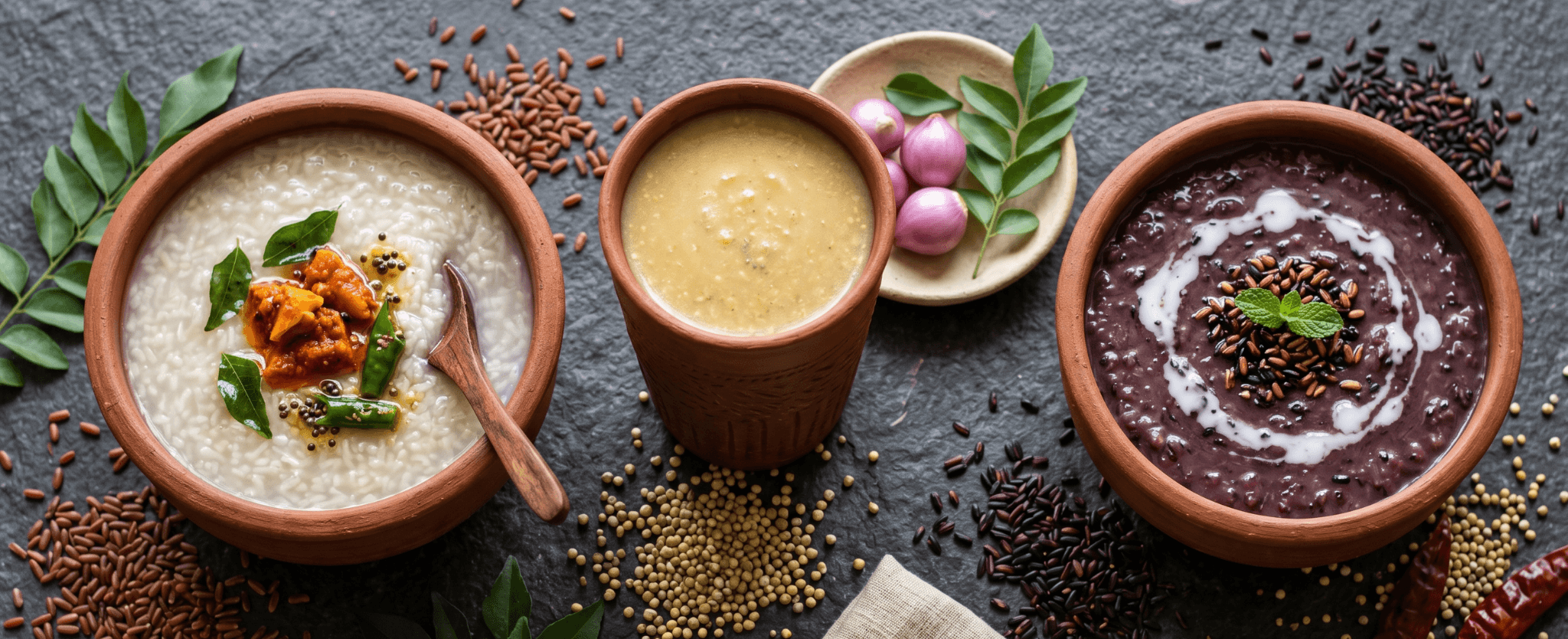
Every culture that has ever grown grain has figured out how to turn it into porridge. In India, this instinct runs particularly deep. Across regions, languages, and seasons, cooked grain thinned with water or milk has served as medicine, comfort food, recovery meal, and daily breakfast for thousands of years. The names change from state to state, the grains change, the spices and accompaniments change, but the idea stays constant: a slow-cooked, easy-to-digest preparation that feeds without taxing.
This article covers four traditional Indian porridge styles, the grains best suited to each, the health needs they address, and how to prepare them at home. Whether you are looking for a meal that supports digestion after an illness, a cooling summer breakfast, a nourishing evening meal, or simply a different way to eat millets and heritage rice, traditional porridges offer a solution that has been refined over generations.
Why Porridge Has Stayed Relevant for So Long
The durability of porridge as a food form comes down to a few practical qualities that no amount of modern food innovation has managed to replicate more cheaply or accessibly. Whole grains cooked slowly in water break down their starches gradually, making them far easier to digest than the same grain eaten as a flatbread or cooked quickly. The extended cooking process partially pre-digests the grain, reducing the work your digestive system needs to do.
For people recovering from fever, stomach infections, or digestive distress, this matters enormously. Indian Ayurvedic texts consistently recommended thin grain preparations as the first foods to reintroduce during recovery. The reasoning was sound then and is supported by modern gastroenterology now: soft, low-fibre, easily digestible carbohydrates are far gentler on an irritated gut than solid, fibrous food.
Beyond the recovery context, traditional porridges made from heritage grains carry genuine nutritional weight. When you cook navara rice as a kanji or use pearl millet for a koozh, the resulting dish provides not just calories but iron, magnesium, B vitamins, and complex carbohydrates that sustain energy over several hours.
Kanji: The Healing Rice Porridge of South India
Kanji is the most widely recognised Indian porridge tradition across South India. The word refers to a thin, watery rice gruel cooked down until the grains are completely soft and the liquid is starchy and smooth. Unlike Western porridges that tend to be thick and creamy, kanji sits lighter in the stomach precisely because of its high water content. The ratio of water to rice is typically four to six parts water for every one part rice, sometimes even more when making a very thin version for recovery purposes.
Which Rice Works Best for Kanji
Traditional kanji was made with whatever rice the household grew or purchased. Today, the choice of rice meaningfully affects both the flavour and the nutritional outcome. Navara rice, a short-grain medicinal variety from Kerala, makes a kanji with exceptional healing properties and has been used in Ayurvedic treatments for centuries. Red rice kanji has a pleasant nuttiness and higher antioxidant content than white rice versions. For everyday use, organic ponni rice produces a reliable, mild kanji that works well with simple accompaniments.
How to Prepare Basic Rice Kanji
Wash half a cup of rice thoroughly. Add it to a heavy-bottomed pot with 3 to 4 cups of water. Bring to a boil, then reduce the flame to very low. Cook uncovered, stirring occasionally, for 25 to 35 minutes until the grains break down and the water becomes slightly opaque and thickened. Add salt to taste. The porridge should flow freely when poured and not hold its shape.
Serve with small accompaniments that do not overwhelm the simplicity of the dish: a small piece of mango pickle, a few drops of sliced shallots with green chilli, or a small bowl of plain yoghurt. For the medicinal version, add a piece of ginger and a pinch of turmeric powder while cooking.
When Kanji Is the Right Choice
- After illness, especially fever or stomach infection, as the first solid food reintroduction
- As a light evening meal on hot days when appetite is reduced
- For elderly family members or young children who need easily digestible nutrition
- As a post-fasting meal that does not shock the digestive system back into activity
Koozh: The Fermented Pearl Millet Drink-Porridge of Tamil Nadu
Koozh occupies a fascinating middle ground between porridge and drink. Made primarily from pearl millet flour (kambu), it is cooked to a thick consistency, then thinned with buttermilk or water and left to ferment slightly before serving. The result is simultaneously a cooling beverage and a filling meal. In Tamil Nadu’s agricultural communities, koozh has historically been consumed by labourers heading into fields in summer, providing hours of sustained energy and natural cooling through fermentation.
The fermentation step is what separates koozh from plain pearl millet porridge. When cooked kambu is left at room temperature with buttermilk for several hours, the natural bacteria in the buttermilk begin fermenting the mixture. This creates lactic acid, which gives koozh its characteristic slight sourness and simultaneously produces probiotic bacteria that support gut health. Summer heat accelerates this fermentation, making koozh a naturally seasonal preparation that is most effective precisely when temperatures are highest.
Making Koozh at Home
Bring 3 cups of water to a boil. Mix one cup of pearl millet flour with half a cup of cold water to form a smooth paste. Add the paste slowly to the boiling water, stirring continuously to prevent lumping. Reduce heat and cook for 8 to 10 minutes until thick, stirring regularly. Remove from heat and allow to cool completely, ideally overnight. The next morning, add a cup of buttermilk, salt to taste, and enough cold water to achieve a thick but pourable consistency. Serve alongside raw shallots, green chilli, and a pinch of salt.
For a version without dairy, skip the buttermilk and instead squeeze half a lemon into the cooled porridge before serving. The texture will be slightly different but the cooling effect remains. Pearl millet flakes can also be used as a quicker alternative to flour-based koozh, soaking in warm water for 10 minutes before adding buttermilk.
Congee-Style Rice Porridge: The All-Day Version
While kanji is thin and watery, the congee-style preparation uses a higher rice-to-water ratio cooked for a longer time, resulting in a thick, creamy porridge where individual grains are no longer visible. This style is common across East and Southeast Asia but has clear parallels in Indian cooking traditions, particularly in the Keralite kanji tradition and the Manipuri rice porridge called chak-hao kheer made with black rice.
For a South Indian-adapted congee, black rice or mappillai samba rice both produce an excellent thick porridge with a deep, distinctive colour and robust flavour. The preparation follows the same principle as kanji but uses less water, around 6 to 8 parts water to 1 part rice, and cooks for 45 to 60 minutes, producing a porridge thick enough to hold a spoon upright briefly before settling.
Savoury vs Sweet Versions
The congee-style porridge adapts equally well to savoury and sweet preparations. For a savoury version, temper cumin seeds and curry leaves in a small amount of groundnut oil, add grated ginger, and stir into the cooked porridge with salt. For a sweet version, use palm sugar or country sugar with a pinch of cardamom and a small spoon of cow ghee. Both versions are equally satisfying and work well as breakfast or as a light dinner.
| Porridge Type | Base Grain | Best Health Use |
|---|---|---|
| Rice Kanji | Ponni, Navara, Red Rice | Recovery, digestion support, light evening meal |
| Kambu Koozh | Pearl Millet Flour or Flakes | Summer cooling, sustained energy, gut health |
| Congee-Style | Black Rice, Mappillai Samba | Deep nutrition, antioxidants, filling meal |
| Millet Porridge | Ragi, Foxtail, Little Millet | Bone health, weight management, diabetic support |
Millet Porridges: The Modern Addition to a Traditional Lineup
While rice-based kanji and millet-based koozh have long histories, the broader category of millet porridges has seen renewed attention in the past decade as awareness of millet nutrition has grown. Each millet variety brings a slightly different nutritional emphasis and flavour profile to a porridge base. Ulamart’s full millets collection covers the range most suited to porridge preparations.
Ragi (finger millet) porridge is perhaps the most established, particularly as a weaning food for infants and a calcium-rich breakfast for older adults and women. Ragi finger millet contains one of the highest natural calcium levels found in any grain, making ragi porridge a meaningful contributor to bone health when eaten regularly. To prepare it, mix finger millet flour with cold water to a paste, add to boiling water, cook for 6 to 8 minutes, then sweeten with palm sugar and a pinch of cardamom.
Foxtail millet porridge, made from foxtail millet, is particularly valued for its relatively low glycaemic response, making it a good breakfast option for people managing blood sugar. Little millet and kodo millet both produce mild, light porridges that are excellent bases for savoury preparations with spiced tempering. A spoonful of drumstick honey stirred into a warm millet porridge just before serving adds subtle sweetness alongside the honey’s own nutritional properties.
Accompaniments That Transform a Porridge into a Meal
Traditional porridges in India were rarely eaten alone. The porridge itself provided the carbohydrate and calorie base, while a small selection of accompaniments added fat, salt, flavour, and often additional nutrition. Understanding these pairings helps you recreate the meal in the way it was historically intended, and also makes it far more satisfying.
| Porridge | Traditional Accompaniments |
|---|---|
| Rice Kanji | Mango pickle, sliced shallots, papad, curd |
| Kambu Koozh | Raw shallots, green chilli, salt, buttermilk |
| Black Rice Congee | Coconut milk drizzle, palm sugar, cardamom |
| Ragi Porridge | Palm sugar, cardamom, warm milk or coconut milk |
| Foxtail Millet Porridge | Tempered cumin and curry leaves, grated ginger |
Across all these pairings, one consistent thread is the use of small amounts of high-quality fat, whether from sesame oil, groundnut oil, ghee, or coconut milk. Fat slows the absorption of the porridge’s carbohydrates, extending the feeling of fullness and adding fat-soluble vitamins. For a deeper understanding of the role of traditional oils in Indian cooking, the Indian Council of Medical Research’s dietary guidelines provide useful context on fat types and their interaction with grain-based diets.
Storing and Preparing Ahead
One of the practical advantages of porridge over other traditional preparations is how well it fits into a busy household routine. Most porridges can be prepared the night before and reheated with a splash of water in the morning. Kambu koozh, by its nature, is better when left overnight because the fermentation requires time. Rice kanji reheats well with minimal loss of quality.
Storing dry grains and flours correctly is just as important as the cooking process. Pearl millet flour and finger millet flour have higher fat content than wheat flour and can go stale faster if kept in warm, humid conditions. Airtight containers away from the stovetop are essential. Whole grains last significantly longer than flours, so grinding small batches as needed is a practical approach for households that cook porridge less frequently.
Making Porridge a Weekly Habit
Introducing traditional porridges into your weekly cooking does not require replacing existing meals. The simplest approach is to substitute one meal per week, typically breakfast, with a porridge made from a heritage grain you already have on hand. Rice kanji on a morning after a heavy dinner the previous evening, kambu koozh on a particularly hot day, ragi porridge on a weekday morning when a quick but nutritious breakfast is needed.
Over time, rotating between different grains and styles builds a cooking habit that naturally incorporates the nutritional diversity that traditional Indian diets were built around. The full range of heritage rice varieties and millets at Ulamart gives you plenty of variety to rotate through without repeating the same preparation for weeks at a stretch.
The practical wisdom embedded in these porridge traditions did not survive thousands of years by accident. It survived because it works, because these preparations genuinely nourish, genuinely aid recovery, and genuinely make difficult seasons more manageable. Returning to them is not nostalgia. It is a straightforward nutritional decision backed by the most long-running food trial in human history.