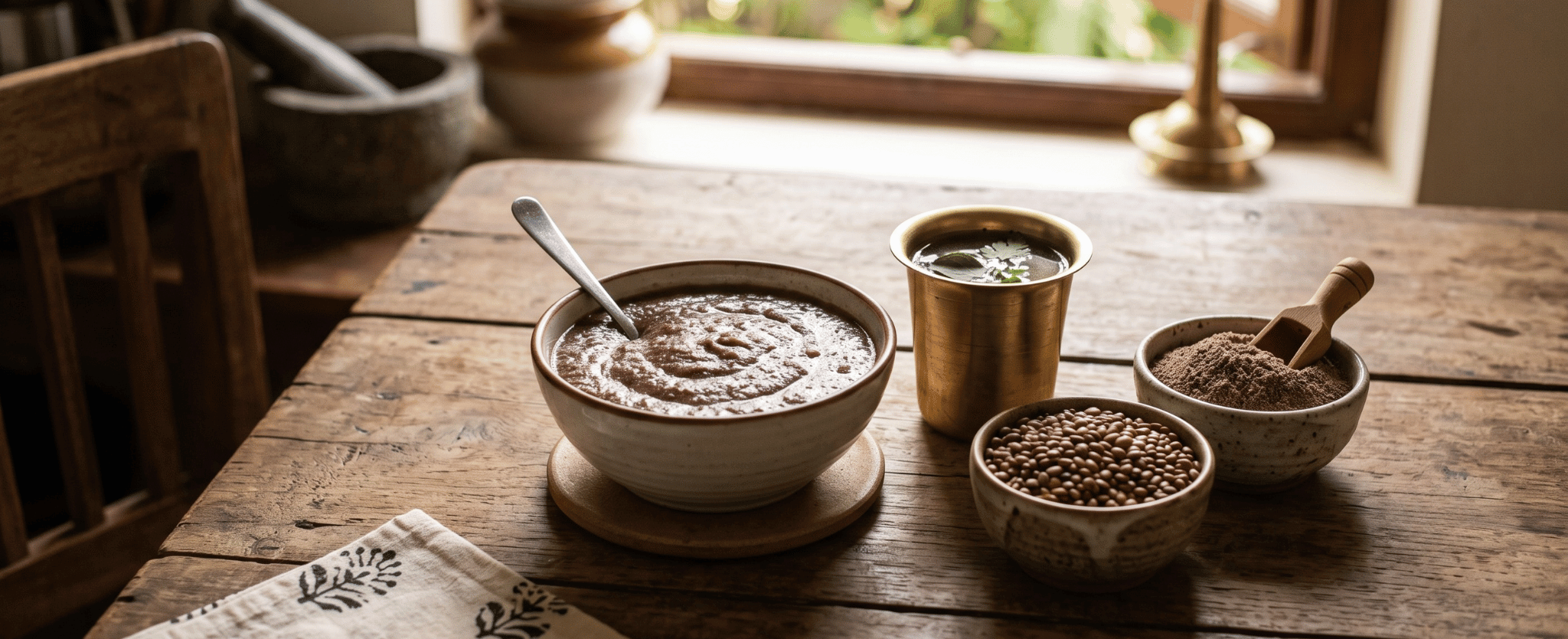
Millets have quietly become a staple recommendation in weight management conversations, and for good reason, ragi and horse gram in particular offer high fibre content and a lower glycemic load compared to polished rice, which helps with sustained fullness rather than the quick spike and crash cycle common with refined grains. What actually makes a difference, though, is how these ingredients are cooked day to day, not just whether they are stocked in the kitchen. Two recipes worth building into a regular rotation are kollu rasam and ragi kanji, both simple enough for daily cooking.
Why Ragi and Horse Gram Work Well for Weight Management
Ragi, or finger millet, carries a notably higher fibre and calcium content than rice, and its slower digestion keeps blood sugar more stable across a meal, which reduces the urge to snack shortly after eating. Horse gram, known as kollu in Tamil, is unusually high in protein for a legume and has traditionally been associated with weight management in South Indian households, largely due to its low fat, high fibre profile that supports satiety without adding excess calories.
Kollu Rasam: A Simple Everyday Recipe
Kollu rasam is a thin, tangy soup made from cooked horse gram, tamarind, and a tempering of mustard seeds, cumin, and curry leaves. Start by pressure cooking a small cup of soaked horse gram until soft, then mash lightly and simmer with tamarind water, a touch of turmeric, and crushed pepper and cumin for warmth. A simple tempering of mustard seeds and curry leaves in a little oil, poured over the rasam at the end, rounds out the flavour. This works well as a light lunch or dinner option, especially paired with a small portion of steamed vegetables rather than rice.
Ragi Kanji: A Filling Breakfast or Light Meal
Ragi kanji is a thin, fermented or freshly cooked porridge made from ragi flour, traditionally consumed as a cooling, filling breakfast. To prepare it fresh, whisk ragi flour into water to avoid lumps, then cook over low heat while stirring continuously until it thickens to a smooth, drinkable consistency. A pinch of salt or a small amount of buttermilk stirred in at the end gives it a pleasant tang, and it can be had on its own or with a small side of steamed vegetables for a more complete meal.
| Recipe | Main Ingredient | Best Time to Eat |
| Kollu Rasam | Horse gram (kollu) | Lunch or dinner, with light vegetables |
| Ragi Kanji | Ragi (finger millet) flour | Breakfast or a light evening meal |
Fitting These Into a Daily Routine
The practical advantage of both these recipes is how little time they take once the routine is set. Ragi kanji can be prepared in under fifteen minutes, making it realistic for a weekday breakfast, while kollu rasam benefits from soaking the horse gram overnight, which means most of the prep happens passively before cooking even begins. Rotating between the two across the week, rather than relying on just one, keeps the diet varied enough to sustain long term rather than becoming a short lived attempt.
- Soak horse gram overnight for faster cooking and easier digestion
- Whisk ragi flour into water before heating to avoid lumps in the kanji
- Pair both recipes with steamed vegetables rather than rice for a lighter, more filling meal
- Rotate between recipes through the week to keep the routine sustainable rather than repetitive
For sourcing quality ragi flour and whole horse gram for these recipes, checking that the packaging is properly labelled and fresh matters as much as the recipe itself, since the fibre and protein benefits depend on using unadulterated, well processed grain rather than blends stretched with fillers.