Walk into most South Indian kitchens today and you will hear two very different opinions about atta. One side swears by the chakki flour their grandmother used, ground slowly between two stones. The other side is happy with whatever packet comes off the supermarket shelf, milled in seconds by steel rollers. Both sides assume they are right, but very few people actually know what happens inside a mill before the flour reaches their kitchen. This piece looks only at that question, how the grinding method itself changes the flour, and whether the difference is big enough to matter for your everyday cooking.
What Happens During Stone Grinding
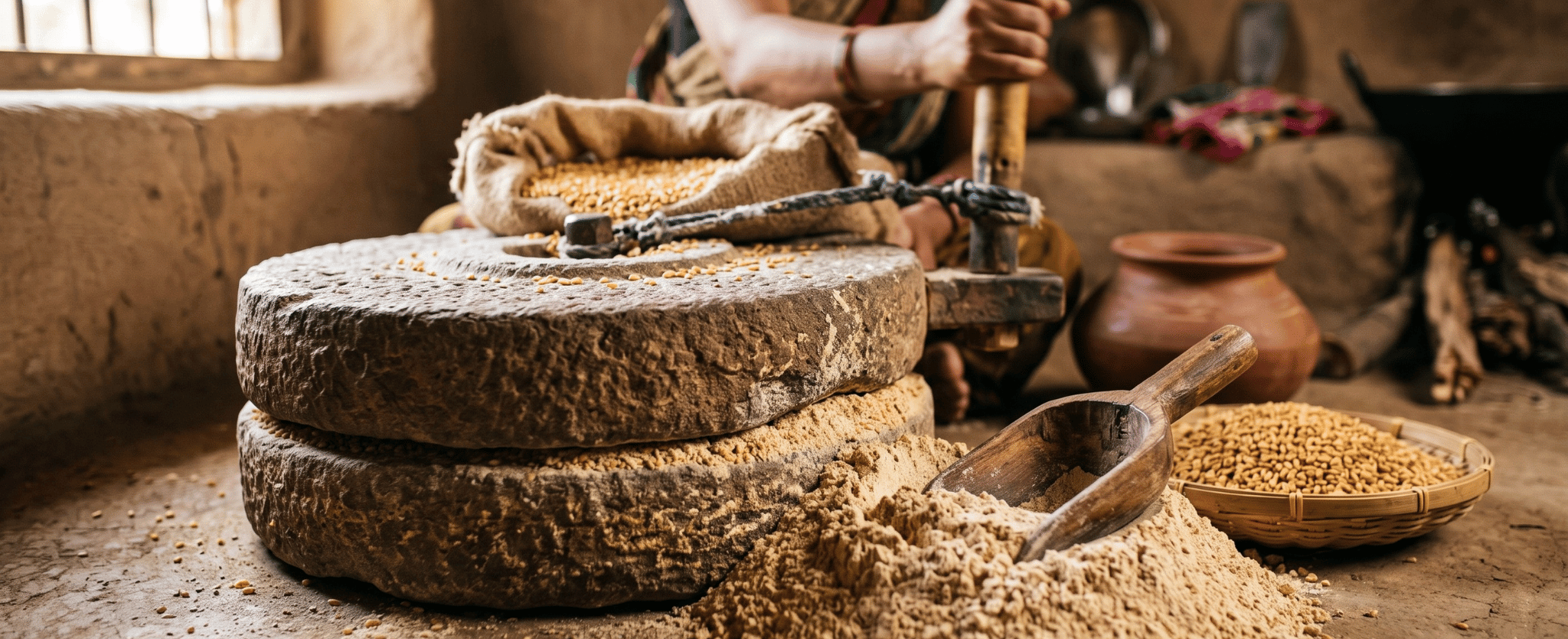
Stone grinding, or chakki milling, passes the whole grain between two heavy stones that rotate slowly, usually somewhere between 20 and 30 revolutions a minute. Because the grain is crushed rather than sliced, the bran, the germ, and the starchy endosperm stay together in the final flour. The slow speed keeps friction low, so the flour does not heat up as sharply as it would in a high speed mill. This matters because several vitamins found in whole grain, particularly vitamin E and the B group, break down when exposed to heat for extended periods.
What Happens During Machine or Roller Milling
Roller milling is the method used by almost every large scale commercial flour brand. Steel rollers spinning at high speed strip the wheat or rice kernel apart, separating the bran and germ from the endosperm in a matter of seconds. The endosperm alone becomes refined flour. For products labelled whole wheat, the separated bran and germ are collected and blended back into the flour afterward, in proportions the manufacturer decides. This process is fast, consistent, and cheap to run at scale, which is exactly why it dominates packaged flour aisles.
| Aspect | Stone Ground Flour | Roller Milled Flour |
| Grinding speed | Slow, 20 to 30 rpm | High speed, continuous |
| Grain components | Bran, germ, endosperm milled together | Separated, then recombined for whole wheat labels |
| Texture | Coarser, uneven particle size | Fine and uniform |
| Shelf life | Shorter, oils are still active | Longer, oils largely removed or stabilised |
Does Nutrient Retention Actually Differ
This is where the marketing gets ahead of the science. It is true that keeping the bran and germ intact through a single gentle pass helps preserve fibre, minerals, and heat sensitive vitamins better than a process that strips the grain apart first. But research on this subject, including work summarised by the Whole Grains Council, points out that the picture is more layered than most blogs admit. Stone mills can sometimes run hotter than expected because of sustained friction, and if a roller mill fully recombines every fraction of the grain, the finished flour can end up nutritionally similar to a stone ground batch. The one consistent advantage of stone grinding is particle size. Coarser, less uniform particles digest more slowly, which can mean a gentler rise in blood sugar after a meal, something researchers have observed when comparing wholegrain breads made from different milling methods.
Taste, Texture, and How They Affect Your Cooking
The coarser particles from stone grinding change more than nutrition. Rotis made from stone ground atta tend to hold moisture differently, often staying soft for longer, while the flour itself carries a nuttier, more pronounced grain flavour because the natural oils in the germ are still present. Roller milled flour, being finer and more uniform, is easier to sieve and gives a smoother dough, which is one reason commercial bakeries lean toward it for consistency. Neither texture is wrong, it depends on whether you are making a rustic ragi kali or a soft, restaurant style paratha.
Shelf Life and Storage
Because stone ground flour retains the germ’s natural oils, those oils can turn rancid faster once exposed to air, heat, and moisture. Most stone ground millet and rice flours are best used within four to six weeks and stored in an airtight container away from direct sunlight, with refrigeration recommended in humid months. Roller milled flour, with much of the germ removed, keeps for several months without the same risk, which is a fair trade off for households that buy flour in bulk and cannot use it up quickly.
How to Check If Your Flour Is Genuinely Stone Ground
Not everything labelled chakki atta on a shelf has actually been through a stone mill. A few quick checks can help.
| What to Check | What It Tells You |
| Colour | A slightly off white or beige tone suggests bran and germ are present, not stripped and bleached |
| Texture between fingers | Genuine stone ground flour feels coarser and slightly gritty, not powder smooth |
| Smell | A nutty, earthy aroma points to intact germ oils, refined flour smells mostly neutral |
| Shelf life claim | A very long shelf life without refrigeration is a sign the germ has likely been removed |
Choosing What Actually Fits Your Kitchen
If your priority is nutrient density, slower digestion, and traditional flavour, stone ground pearl millet flour or rice flour is the more reliable choice, provided you store it correctly and use it within a reasonable window. If convenience and a longer shelf life matter more for your household, a good quality roller milled whole grain flour is not the villain it is sometimes made out to be, especially when the bran and germ are properly recombined. Some home cooks go a step further and grind small batches themselves using a traditional stone mortar and pestle, which keeps the process as close to fresh milling as a home kitchen allows. Either way, reading the label carefully and buying from a source you trust matters more than chasing a single word printed on the packet.