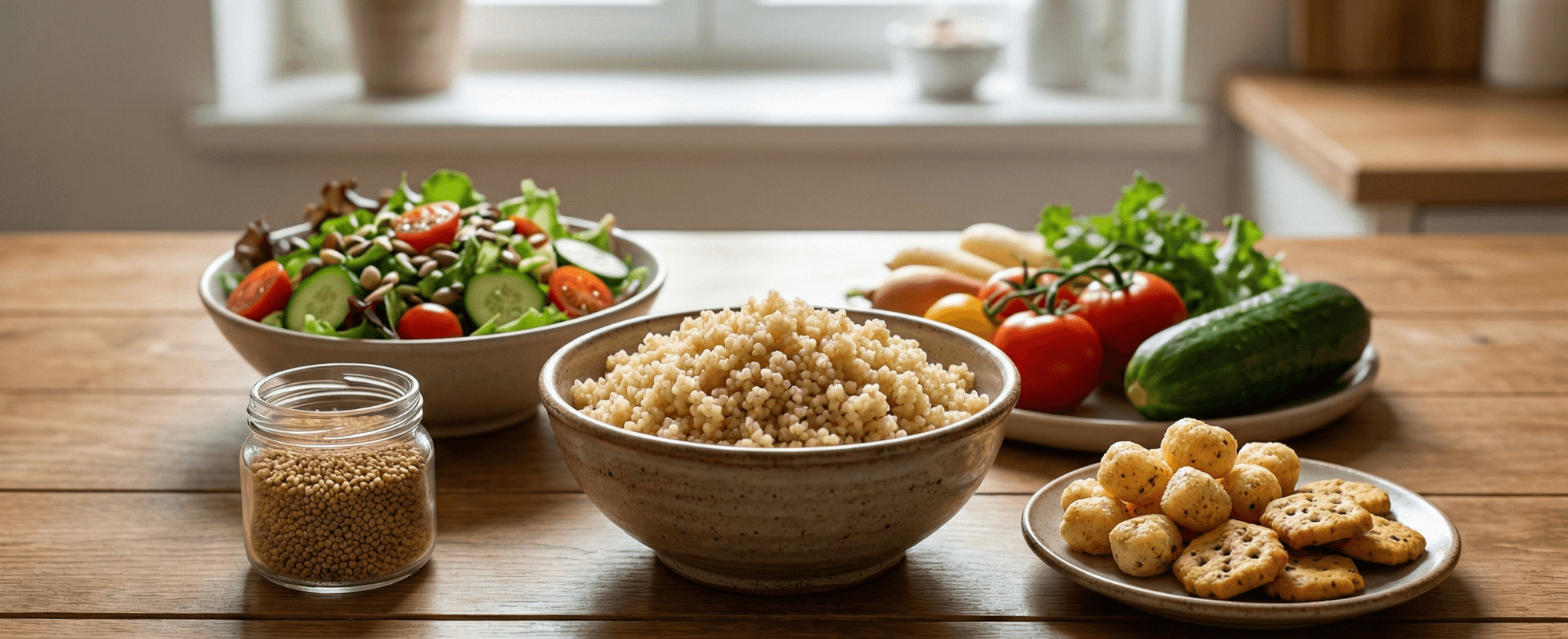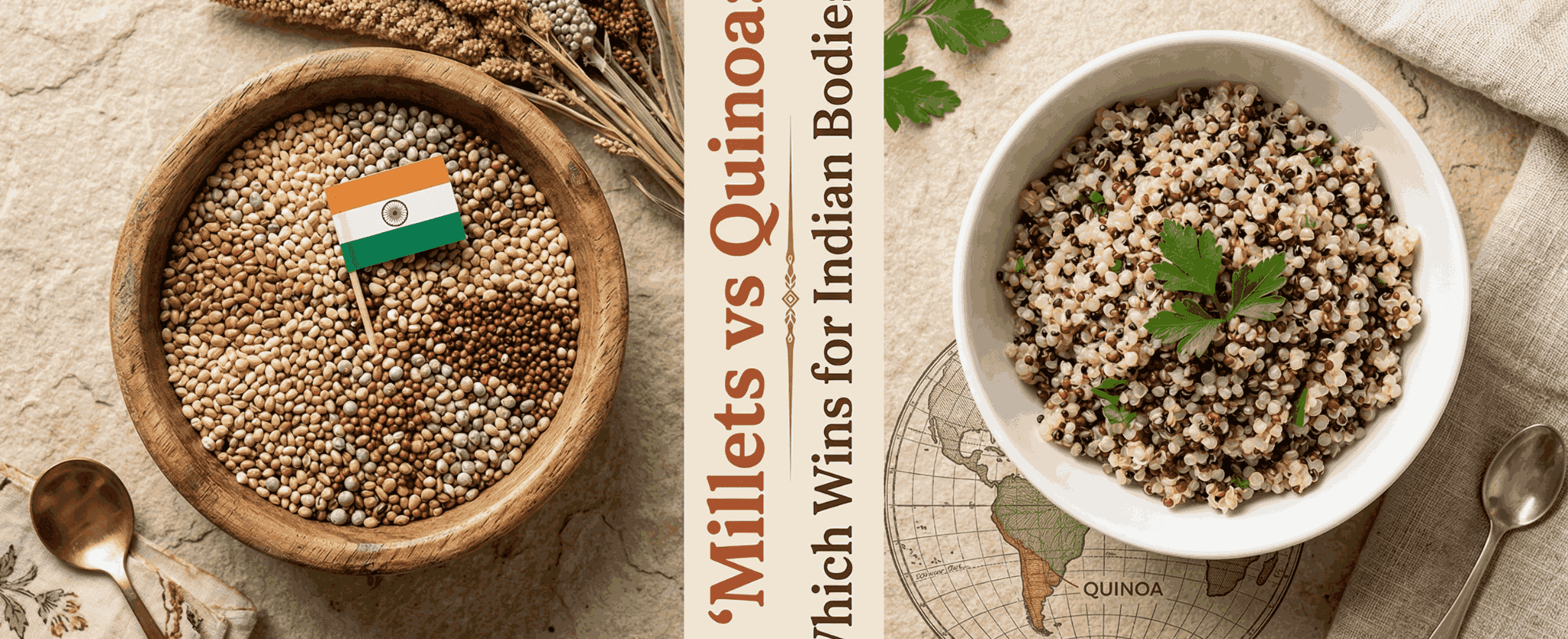
Over the last decade, quinoa has established itself as the default grain of the health-conscious Indian middle class. It appears on restaurant menus as a salad base, in diet plans as a protein-rich alternative to rice, and in grocery carts as proof that someone is paying attention to what they eat. Quinoa is good. This article does not dispute that. What it disputes is the assumption that quinoa is better than what India already has.
India is home to five to seven species of cultivated millet that have fed the subcontinent for 5,000 years. Foxtail millet, kodo millet, barnyard millet, pearl millet, finger millet (ragi), and little millet were once eaten daily by hundreds of millions of people across every region of the country. They were abandoned not because they were nutritionally inferior but because the Green Revolution of the 1960s directed agricultural subsidies, distribution infrastructure, and cultural preference toward wheat and rice. Millets became associated with poverty. Quinoa, arriving with a premium price and a Western health narrative, stepped into the nutritional reputation that millets never stopped deserving.
This comparison examines the actual numbers. Protein content, glycaemic index, fiber, minerals, environmental footprint, and cost: across every dimension that matters for an Indian household eating three meals a day in India’s climate and food culture, the case for millets over quinoa is compelling.
The Protein Question: Where Quinoa’s Reputation Comes From
Quinoa is frequently described as a complete protein because it contains all nine essential amino acids in meaningful quantities. This is nutritionally accurate and was a significant point in quinoa’s favour over rice and wheat, which are lysine-deficient. The protein content of quinoa sits at 14 to 15 grams per 100 grams of dry grain, which is genuinely impressive for a plant food.
What the quinoa conversation rarely includes is the protein profile of Indian millets, because that comparison makes quinoa look considerably less exceptional. Foxtail millet contains 12.3 grams of protein per 100 grams. Finger millet (ragi) provides 7.3 grams but does so alongside 344 mg of calcium, a nutrient where quinoa (47 mg per 100 grams) cannot compete. Pearl millet carries 11.8 grams of protein, plus 8 mg of iron per 100 grams, far exceeding quinoa’s 2.8 mg. Kodo millet provides 9.8 grams of protein alongside one of the lowest glycaemic indices of any grain.
The complete protein argument is also more nuanced than it appears. In Indian food culture, grains are almost never eaten alone. Dal and rice, ragi with buttermilk, millet with sambar: these traditional combinations produce complete amino acid profiles through food pairing that makes the single-food completeness of quinoa a less compelling differentiator than it sounds in isolation.
Head-to-Head Nutritional Comparison
| Nutrient (per 100g dry) | Quinoa | Top Indian Millet |
| Protein | 14.1 g | 12.3 g (foxtail) |
| Dietary Fiber | 7.0 g | 11.5 g (pearl millet) |
| Iron | 2.8 mg | 8.0 mg (pearl millet) |
| Calcium | 47 mg | 344 mg (ragi/finger millet) |
| Glycaemic Index | 53 | 50 to 54 (foxtail, kodo) |
| Magnesium | 197 mg | 133 mg (pearl millet) |
| Price per kg in India | Rs 350 to 600+ | Rs 80 to 200 |
Reading this table, the picture that emerges is not quinoa versus millets in which one wins across the board. It is quinoa versus a collection of Indian millets, each with a different nutritional strength, together outperforming quinoa across every category that matters most for Indian dietary gaps: calcium deficiency (addressed by ragi), iron deficiency (addressed by pearl millet and barnyard millet), blood sugar management (addressed by foxtail, kodo, and little millet), and fiber for gut health (addressed by pearl millet, ragi, and kodo).
Glycaemic Index: Why Both Grains Perform Similarly
One of quinoa’s most cited advantages over white rice is its glycaemic index of 53, which is classified as low. This is a legitimate benefit. But every commonly eaten Indian millet has a glycaemic index in the same range or lower. Foxtail millet sits at 50 to 55. Kodo millet, which has received particular research attention for its blood sugar effects, registers between 49 and 52. Little millet (samai) comes in at 54 to 57. Barnyard millet, often considered the lowest GI grain available in India, registers around 50.
The practical implication is straightforward. If blood sugar management is the reason for choosing quinoa over white rice, any Indian millet achieves the same goal at a fraction of the cost, with a culinary tradition that already knows how to cook them well, and with the added benefit of much higher fiber content in most millet varieties compared to quinoa. The kodo millet blog on Ulamart discusses this blood sugar benefit in detail alongside practical meal ideas using this ancient grain.
Read Ulamart’s detailed guide on kodo millet for weight loss and blood sugar management for a complete breakdown of how this single millet performs against processed grain alternatives.
Where Indian Millets Leave Quinoa Behind: Iron and Calcium
The Iron Deficiency Crisis in India
India has one of the highest rates of iron deficiency anaemia globally. The National Family Health Survey has consistently documented that more than half of Indian women and children are anaemic. In this context, the iron content of grains is not merely a nutritional statistic. It is a direct public health concern.
Quinoa provides 2.8 mg of iron per 100 grams. Pearl millet provides 8.0 mg, nearly three times as much. Barnyard millet provides 15.2 mg, more than five times as much. For an Indian woman eating grain as a daily staple, the choice between quinoa and pearl millet is a choice between 2.8 mg and 8 mg of iron at every meal. Over months and years of daily consumption, that difference is clinically meaningful, particularly when paired with vitamin C-rich foods like tamarind, tomato, and lemon juice that are already embedded in Indian cooking and that dramatically increase non-heme iron absorption.
The Calcium Gap Quinoa Cannot Bridge
Calcium deficiency affects millions of Indians, particularly women, as dairy consumption declines in urban populations and awareness of plant-based calcium sources remains low. Quinoa provides 47 mg of calcium per 100 grams. Finger millet (ragi/kezhvaragu) provides 344 mg per 100 grams, nearly seven times more than quinoa and nearly three times more than cow’s milk per equivalent serving. No imported superfood comes close to ragi in calcium delivery from a whole-food plant source.
The Ulamart blog covers the calcium content and bone health implications of ragi in detail at Ragi: The Calcium Powerhouse for Strong Bones, which includes practical daily preparation ideas.
For those looking to incorporate finger millet into daily cooking, Ulamart’s organic ragi (finger millet) is organically grown and available in whole grain form.
The Environmental Case: Local Grains for a Local Climate
Quinoa is grown primarily in Bolivia and Peru, at high altitudes under specific climatic conditions. Getting it to India requires international shipping across tens of thousands of kilometres. The carbon footprint of this supply chain is real and measurable, and it is entirely absent from the health narrative that makes quinoa appealing.
Indian millets, by contrast, are among the most water-efficient, climate-resilient crops on earth. Pearl millet grows in the arid zones of Rajasthan on minimal water. Foxtail millet thrives in the dry red-soil regions of Andhra Pradesh and Karnataka. Barnyard millet grows in hilly, marginal land where no other food crop would survive. These grains have been adapted to the Indian subcontinent’s diverse climatic zones over thousands of years of cultivation. They require no synthetic fertilisers when grown organically, fix nitrogen in soil, and leave the land better than they found it.
The 2023 United Nations Food and Agriculture Organization report on millet sustainability specifically highlighted Indian millet varieties as model crops for climate-resilient food systems globally, noting their exceptional water efficiency: pearl millet requires approximately 350 mm of rainfall annually compared to 1,200 mm for rice. Choosing Indian millets over imported quinoa is therefore not only a nutritionally sound decision. It is one with a smaller environmental footprint by every measurable standard.
The Cost Reality: A Comparison Indian Families Cannot Ignore
Quinoa retails in Indian markets at approximately Rs 350 to 600 per kilogram, depending on brand and quality. This price reflects import duties, international shipping, distributor margins, and the premium associated with its superfood marketing. Organic quinoa consistently costs more.
Every Indian millet is available for a fraction of this price. Foxtail millet costs approximately Rs 80 to 120 per kilogram at Ulamart. Kodo millet is similarly priced. Organic barnyard millet and pearl millet fall in the same range. Finger millet (ragi) is among the most affordable superfoods in the Indian pantry at Rs 60 to 100 per kilogram depending on quantity purchased.
For a family of four eating two grain-based meals per day, the cost difference between a quinoa-based diet and a millet-based diet amounts to several thousand rupees per month. Over a year, that difference funds the kind of nutritional variety, including organic purchasing, fresh produce, and quality pulses, that no single expensive imported grain can provide on its own.
| Grain | Approx Price/kg (India) | Local Availability |
| Quinoa (imported) | Rs 350 to 600 | Specialty stores, online only |
| Foxtail Millet (Thinai) | Rs 80 to 120 | Widely available, local farmers |
| Kodo Millet (Varagu) | Rs 80 to 120 | South India, organic stores |
| Pearl Millet (Kambu) | Rs 50 to 90 | Across India, most markets |
| Finger Millet/Ragi | Rs 60 to 100 | South India, widely available |
| Barnyard Millet (Kuthiraivali) | Rs 100 to 160 | South India, online stores |
Cooking and Culinary Integration: Where Millets Win by a Wide Margin
Quinoa cooks reasonably well in Indian preparations with some adaptation. But it is fundamentally a South American grain with a flavour profile and texture that does not emerge naturally from Indian spice combinations, cooking fats, or preparation traditions. Making quinoa taste genuinely good in Indian food requires learning a new cooking language.
Indian millets were developed alongside Indian cuisine. Foxtail millet cooked with a cumin-ginger tadka and a squeeze of lemon becomes a pongal with character that plain rice cannot match. Kodo millet pressure-cooked with toor dal and eaten with sambar is so similar to rice that most family members will not notice the difference during the first few weeks of switching. Ragi dissolved in buttermilk with salt, pepper, and curry leaves is the kanji that millions of Tamil families grew up drinking. Barnyard millet forms perfect idli and dosa batter when blended with urad dal and allowed to ferment overnight.
This culinary compatibility is not trivial. It determines whether a dietary change is sustainable over months and years or abandoned within weeks. Millets integrate into the existing Indian cooking repertoire without requiring new equipment, new skills, or new recipes. Quinoa requires all three for consistently good results.
Digestibility and Gut Compatibility for Indian Bodies
Digestibility is one of the most undervalued dimensions of grain comparison. A food that causes bloating, discomfort, or digestive irregularity is not a food you will eat consistently, regardless of its nutritional credentials.
Quinoa contains saponins, bitter coating compounds that must be thoroughly rinsed before cooking. Inadequately rinsed quinoa causes digestive irritation in many people. Even well-rinsed quinoa contains lectins and phytic acid that can reduce mineral absorption. This is not a dealbreaker, but it is a real consideration.
Traditional Indian millets have been consumed for thousands of generations by the specific gut microbiomes that developed in Indian populations eating Indian food. Fermented millet preparations like idli batter made from barnyard or foxtail millet are probiotic in nature and directly support the gut bacteria populations common in Indian digestive systems. Ragi porridge has been the first solid food for South Indian infants for centuries, reflecting an understanding that these grains are among the most digestible available. There is no equivalent generational data for quinoa in Indian populations.
Ulamart’s guide to barnyard millet as an everyday fasting grain explores how this particular millet supports digestion and gut health through its unique fiber composition.
Who Benefits Most from Which Grain
Quinoa has genuine advantages in specific contexts, and acknowledging them honestly makes the broader argument for millets more credible, not less. If you live in South America, quinoa is an excellent local grain with deep cultural roots and excellent nutritional credentials. If you are cooking for someone with a specific lysine deficiency who cannot pair grains with legumes for health reasons, quinoa’s complete amino acid profile in isolation has value. If you are a competitive athlete looking to maximise plant protein from a single grain source, quinoa’s 14 grams per 100 grams is slightly ahead of most individual millets.
For everyone else in India, the millet portfolio is superior in every measurable way that matters for the Indian context. Children need calcium more than they need quinoa’s marginal protein advantage: ragi addresses this directly. Women need iron at levels that quinoa cannot deliver: pearl millet does. Diabetics need low GI grains that integrate naturally into Indian meals: foxtail and kodo millet do. Anyone managing weight needs high fiber grains that produce lasting satiety: pearl millet and ragi both deliver. Anyone cooking for a family on a realistic budget needs grains that cost one-fifth as much as imported alternatives: every Indian millet qualifies.
| Health Goal | Best Indian Millet | Why |
| Calcium and bone health | Ragi (finger millet) | 344 mg calcium per 100g |
| Iron and anaemia | Pearl millet / barnyard millet | 8.0 to 15.2 mg iron per 100g |
| Blood sugar management | Kodo millet / foxtail millet | GI 49 to 55, high resistant starch |
| Weight management | Kodo millet / little millet | Low calorie density, high satiety |
| Gut health and digestion | Barnyard millet / foxtail millet | Prebiotic fiber, ferments well |
| Budget-conscious nutrition | All Indian millets | Rs 50 to 160 per kg vs Rs 350 to 600 |
A Practical Guide to Switching from Quinoa or White Rice to Millets
The biggest barrier to millet adoption is not nutrition or cost. It is the unfamiliarity that comes from a generation of households that stopped cooking millets. The following approach makes the transition practical and sustainable.
Week One: Start with the Easiest Substitutions
- Replace white rice with foxtail millet (thinai) in pongal, khichdi, or upma. The texture and neutral flavour make this substitution almost invisible
- Use kodo millet (varagu) cooked in a 1:2 grain-to-water ratio wherever you would serve plain steamed rice
- Add ragi flour to your existing idli batter at a 20 percent ratio to start. Increase the proportion weekly
Week Two: Introduce Fermented Millet Preparations
- Prepare barnyard millet dosa batter by soaking barnyard millet and urad dal in a 3:1 ratio for 6 hours, grinding, and fermenting overnight
- Make ragi kanji by dissolving two tablespoons of ragi flour in cold water, then adding to boiling water and cooking until thick. Serve with buttermilk and a pinch of salt
Week Three: Millet Rotation
- Establish a weekly millet rotation: foxtail millet on Monday, kodo millet on Wednesday, barnyard millet on Friday, ragi preparation daily
- Keep pearl millet for winter months or iron-supplementing meals specifically
Shop organic foxtail millet (thinai), kodo millet (varagu), and organic barnyard millet (kuthiraivali) at Ulamart to build your full weekly millet rotation from a single trusted source.
Reclaiming What Was Never Actually Inferior
The marketing success of quinoa in India rests on a historical accident. The Green Revolution did not make millets inferior. It made them invisible. When quinoa arrived as an imported health food from abroad, it filled a gap left not by millets being nutritionally outcompeted, but by millets being culturally displaced.
The Indian government’s declaration of 2023 as the International Year of Millets, a proposal that was adopted by the United Nations, represents the beginning of a formal recalibration. Countries across Asia and Africa that had similarly moved away from millet cultivation are now being encouraged to return to these crops for food security, climate resilience, and nutritional diversity reasons. India, which had the strongest millet tradition of any country on earth, is in the best position to lead this return.
The United Nations Food and Agriculture Organization’s millet initiative documents the global case for millet as the grain system of the future, grounded in the exact same arguments that make individual millet varieties nutritionally and environmentally superior to imported alternatives.
For the Indian consumer reading this, the return to millets is not a sacrifice. It is not eating less well in service of a principle. The ragi laddu, the foxtail millet pongal, the kodo millet khichdi with toor dal: these are meals that taste better than the quinoa salad that costs four times as much, nourish more specifically to Indian nutritional gaps, cook in familiar ways in familiar kitchens, and carry five thousand years of documented human health behind them. That is what local grains winning for local people actually looks like.
Note: Nutritional values cited are approximate figures from published food composition databases including the Indian Food Composition Tables (IFCT 2017). Values may vary by variety and growing conditions.