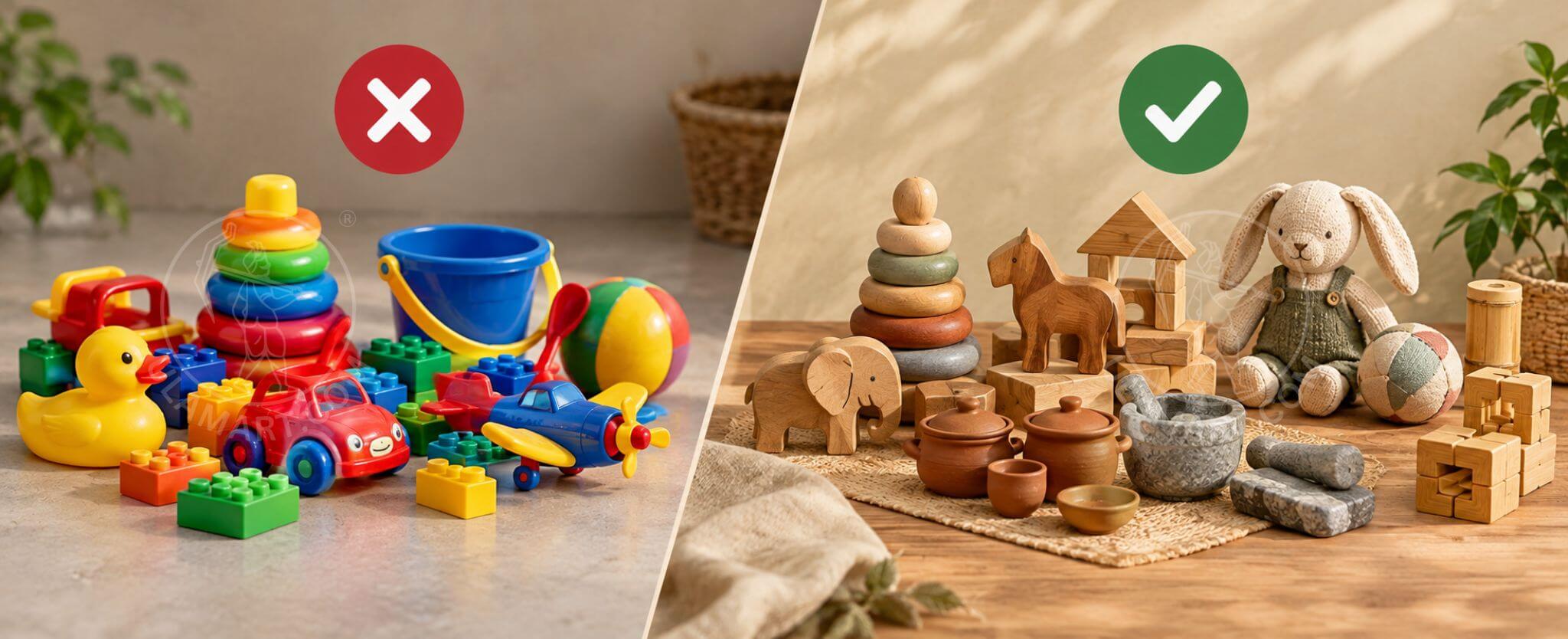
Looking for the best eco-friendly, non-plastic toys for kids? Traditional materials such as clay, stone, wood, organic cotton and bamboo offer wonderful alternatives to conventional plastic toys.
These natural-material toys can make playtime more tactile, creative and open-ended while introducing children to traditional crafts, everyday objects and natural materials.
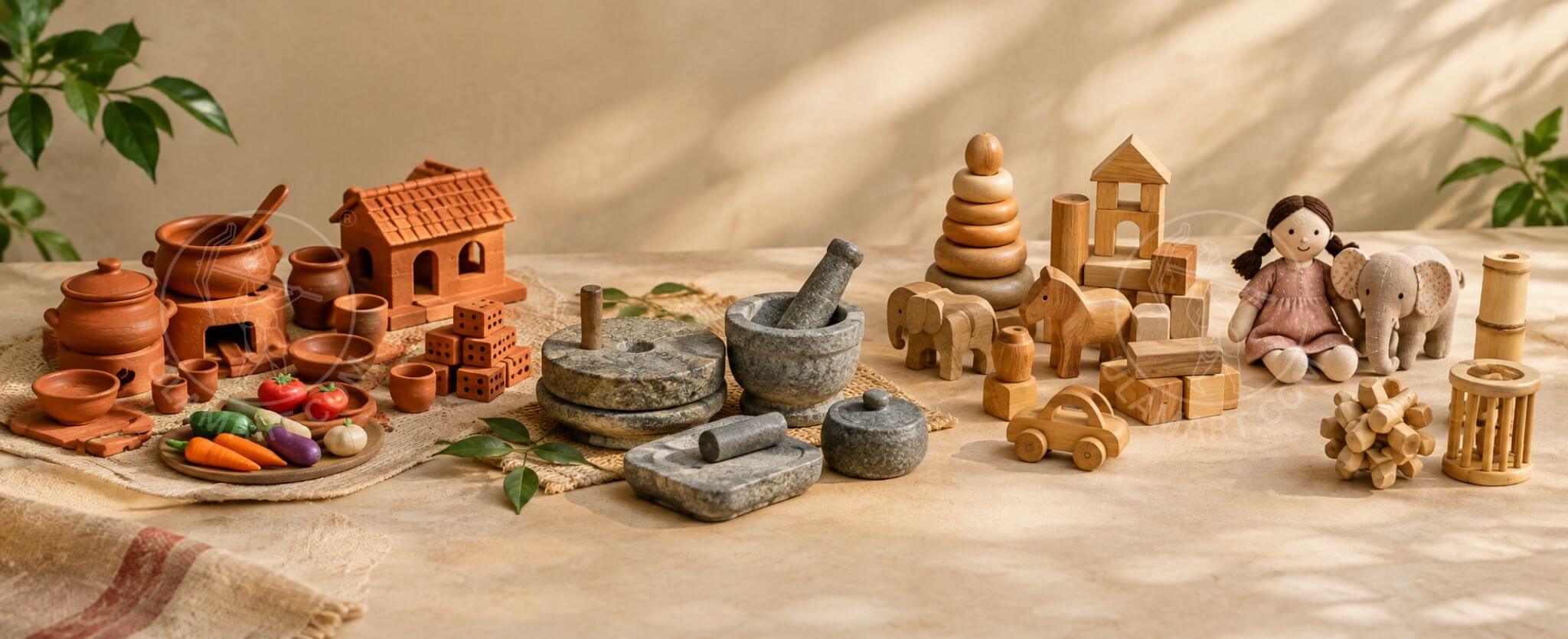
Among these choices, clay and stone toys deserve special attention. Miniature clay kitchen sets, clay vegetable sets, miniature clay houses and brick-building sets can turn familiar elements of traditional Indian life into imaginative play materials. Similarly, miniature stone kitchen tools, mini mortar and pestle sets and traditional grinder models can introduce children to objects that have been part of Indian households for generations.
The goal isn’t simply to replace one toy material with another. It is to choose toys that encourage imaginative play, hands-on exploration, pretend play, sensory learning and thoughtful consumption.
Why Choose Non-Plastic and Eco-Friendly Toys for Children?
Parents looking for plastic-free toys, sustainable toys and natural-material toys are increasingly interested in products that are simple, durable and designed for active participation rather than passive entertainment.
Open-ended toys are particularly interesting because there isn’t necessarily one fixed way to play with them. A set of blocks, miniature utensils or natural objects can become a kitchen, shop, construction site, garden or imaginary village depending on the child’s imagination.
Natural-material toys are also associated with tactile experiences because children can experience differences in weight, texture, temperature, shape and surface rather than interacting with a uniform plastic surface.
However, eco-friendly does not automatically mean safe. Parents should still check age recommendations, small-part/choking risks, sharp edges, splinters, breakage, paints, coatings and applicable toy-safety certifications. In India, buyers should look for appropriate BIS certification, while internationally sold toys may reference standards such as EN 71 or ASTM F963.
The 5 Best Eco-Friendly, Non-Plastic Toy Materials for Kids
Our five natural-material categories are:
- Clay toys
- Stone toys
- Wooden toys
- Organic cotton toys
- Bamboo toys
Each material offers a different type of play experience.
1. Clay Toys for Kids | Traditional, Creative & Tactile
Clay toys are one of the most interesting alternatives to plastic toys, particularly when they are inspired by traditional Indian objects and everyday life. Clay has a natural, earthy appearance and can be shaped into miniature versions of objects children already see around them. Instead of giving a child a plastic imitation kitchen, imagine giving them a small traditional clay kitchen set. The child can create an imaginary kitchen, pretend to cook, arrange utensils, serve food and recreate scenes from everyday family life.
Some Popular Clay Toys for Children include:
- Miniature Clay Kitchen Set: A miniature clay kitchen set can include small traditional-style vessels, pots, pans, cups and serving pieces. It is particularly suitable for pretend kitchen play, role play and imaginative storytelling. Children can pretend to, Cook imaginary meals, Serve food & Organize a kitchen, Play restaurant, Play family roles, Create their own stories This makes a clay kitchen set much more than a decorative miniature collection.
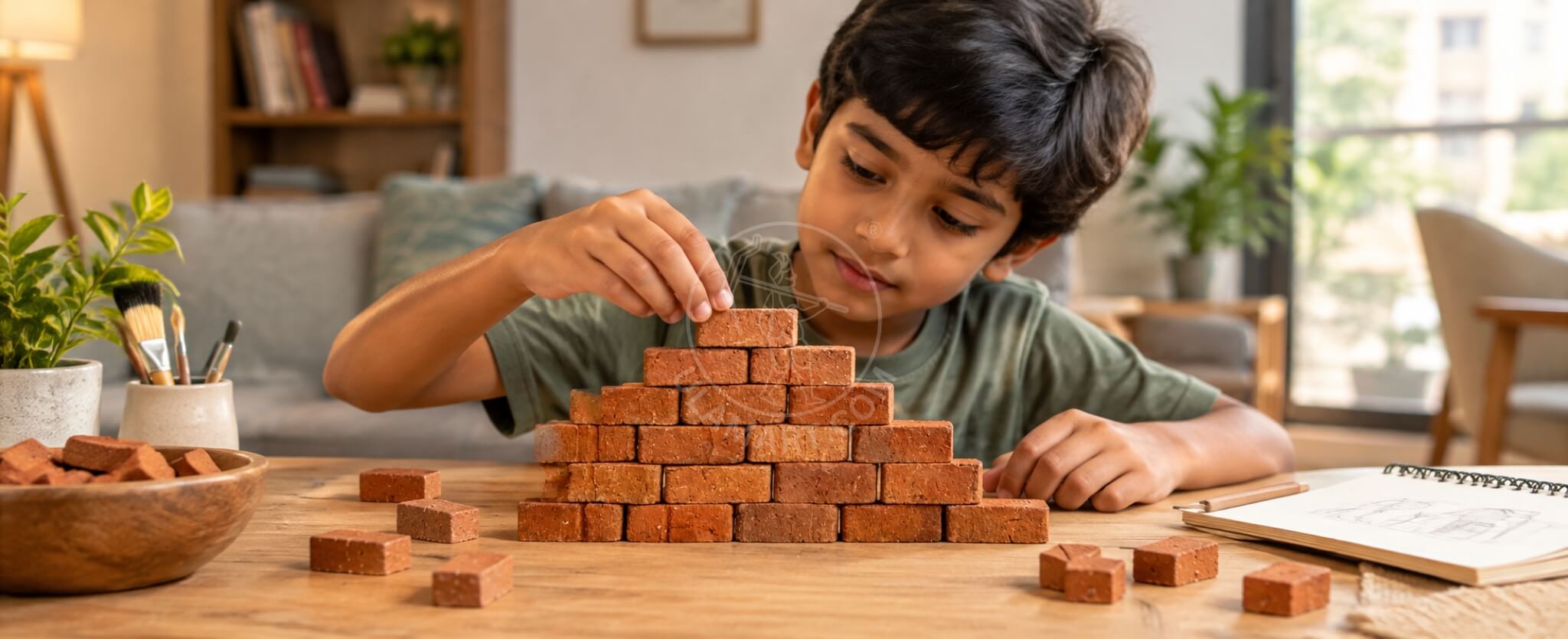
- Miniature Clay Bricks Set: A miniature clay brick set can transform construction into imaginative play. Children can experiment with, Building tiny walls, Making miniature houses, Creating pathways, Designing imaginary villages, Constructing small structures &Rebuilding them in different ways. This type of toy can also introduce children to the basic idea that buildings are made by assembling individual components.
- Mini Clay Vegetable Sets: A miniature clay vegetable set is another excellent option for pretend play. Children can use miniature clay vegetables in, Pretend kitchens, Grocery-store games, Market games, Sorting activities, Cooking role play & Storytelling. A child can pretend to become a farmer, vegetable seller, chef or customer. This makes the toy particularly useful for imaginative and role-based play.
- Miniature Clay Houses: A miniature clay house can become the centre of an entire imaginary world. Children can create, Family stories, Village scenes, Farm scenes, Miniature neighborhood, Festival scenes & Pretend communities Add miniature clay people, animals, vegetables, utensils and bricks and the child can gradually build an entire miniature clay world.
Why Clay Toys Are Special?
Clay toys can connect children’s play with traditional crafts, local materials and cultural objects. Indian craft traditions include a long history of clay and terracotta work, and contemporary sustainable-toy guides increasingly highlight handcrafted clay and other traditional materials as alternatives to mass-produced plastic toys. For parents interested in Indian traditional toys, sustainable Indian crafts, handmade toys and screen-free play, clay toys can therefore be particularly appealing.
2. Stone Toys for Kids: Natural Weight, Texture & Traditional Play
Stone toys are perhaps one of the most unusual categories in the world of children’s toys. Unlike lightweight plastic toys, stone naturally introduces weight, hardness and texture into play. This category is particularly interesting when stone is used to create miniature versions of traditional household tools. However, because stone is hard and can break or create sharp edges, age suitability and supervision are especially important. Products should be appropriately manufactured for children’s use rather than simply repurposing ordinary household stone objects.
- Miniature Stone Kitchen Set: A miniature stone kitchen set can include small traditional grinding, cooking or serving implements. Depending on the design, children can use these pieces for: Pretend cooking, Traditional kitchen role play, Storytelling, Imitative play & Cultural exploration. It can be particularly fascinating for children who see traditional kitchen tools being used by parents or grandparents.
- Mini Stone Mortar & Pestle: The mini mortar and pestle is one of the most recognizable traditional kitchen tools. A child-sized, purpose-made miniature version can introduce children to the concept of: ingredient → grinding → mixing → cooking. It can also become part of a pretend kitchen. For example, children can use it during supervised pretend play to imitate grinding spices, herbs or other play ingredients. The important distinction is that a toy should be specifically manufactured and tested for the intended age group rather than assuming that a small household mortar and pestle is automatically appropriate for a child.
- Miniature Traditional Grinder: A miniature traditional stone grinder can make an especially interesting educational and cultural toy. Traditional grinding stones such as the ammikkal and related grinding tools have a strong connection to Indian culinary traditions. A miniature toy version can be used for Pretend cooking, Cultural storytelling, Role play, Traditional-life demonstrations and Parent-child conversations about food history This is where sustainable toys can become more than entertainment: they can become a way of introducing children to objects, traditions and skills from everyday life.
Other Stone Toy Ideas
The stone category can include:
- Mini stone kitchen utensils
- Mini grinding stones
- Mini mortar and pestle
- Stone-inspired balancing toys
- Natural stone sorting sets
- Stone texture exploration sets
- Traditional miniature kitchen tools
For younger children, avoid loose small stones or poorly finished pieces that could present choking, sharp-edge or breakage hazards.
3. Wooden Toys – The Classic Natural Toy Choice
Wood is probably the most established natural material in the modern eco-friendly toy market. Common wooden toys include: Building blocks, Shape sorters, Puzzles, Stacking toys, Pull-along toys, Pretend kitchen sets, Wooden animals and Balancing toys. Wooden toys are often associated with open-ended and Montessori-inspired play, particularly when they are simple, tactile and child-directed. For sustainable purchasing, look for responsibly sourced wood, smooth construction and child-safe finishes. Where relevant, certifications such as FSC can provide information about responsible forestry, while toy-safety certification addresses a different question: whether the finished toy meets applicable safety requirements.
4. Organic Cotton Toys – Soft, Lightweight & Comforting
Organic cotton is particularly suitable for soft toys, dolls, cloth books, sensory toys, stuffed animals and fabric play accessories. Examples include: Organic cotton dolls, Cloth animals, Soft balls, Fabric books, Play mats, Quiet books and Pretend-play accessories. The biggest difference between cotton and materials such as clay or stone is the sensory experience.
Clay = earthy and shapeable
Stone = heavy and textured
Wood = firm and natural
Cotton = soft and comforting
When purchasing organic cotton toys, look for credible information about the fabric and dyes rather than relying solely on the word “organic.”
5. Bamboo Toys – Renewable & Lightweight
Bamboo is another popular material in the sustainable-products space. Bamboo toys can include: Building blocks, Puzzles, Musical toys, Sorting toys, Stacking toys, Construction sets, Kitchen-play accessories, Bamboo is often promoted as a rapidly renewable plant material, making it attractive for environmentally conscious product design., As with wood, however, the sustainability of the finished product depends on more than the raw material. Adhesives, coatings, paints, manufacturing processes and packaging should also be considered.
Clay vs Stone vs Wood vs Organic Cotton vs Bamboo
| Material | Typical Toy Examples | Play Experience | Particularly Suitable For |
|---|---|---|---|
| Clay | Kitchen sets, vegetables, bricks, houses | Tactile, imaginative, cultural | Pretend play & storytelling |
| Stone | Mortar & pestle, grinders, miniature kitchen sets | Weight, texture, traditional | Supervised pretend & cultural play |
| Wood | Blocks, puzzles, stackers, kitchen sets | Building, sorting, open-ended play | Construction & learning |
| Organic Cotton | Dolls, animals, books, soft toys | Soft, sensory, comforting | Younger children’s soft play |
| Bamboo | Puzzles, blocks, musical toys | Lightweight, constructive | Building & creative play |
Why Clay and Stone Toys Deserve More Attention
The most interesting aspect of clay and stone toys is that they can introduce children to real-world objects rather than purely fictional toy designs. A miniature clay pot can resemble something found in a grandmother’s kitchen. A clay vegetable can become part of a pretend market. A miniature clay brick can become part of a tiny house. A stone mortar and pestle can introduce a traditional grinding process. A miniature grinder can start a conversation about how food was prepared before modern electric appliances. This creates an opportunity for intergenerational learning. Grandparents can explain what a grinding stone was used for. Parents can show children how traditional kitchens worked. Children can recreate these experiences through pretend play. The toy therefore becomes a bridge between play, culture, imagination and everyday life.
Eco-Friendly Toys as Educational Gifts
Sustainable toys can also make meaningful gifts because they don’t have to be limited to entertainment. Instead of giving a child another battery-operated toy, consider a gift that encourages them to build, imagine, sort, pretend, create or discover.
- Birthday Gifts: A miniature clay kitchen set can make an interesting birthday gift for a child who enjoys pretend play.
- Diwali Gifts: Traditional clay toys, miniature houses, clay utensils or handcrafted toy sets can complement the cultural character of Diwali gifting.
- Return Gifts: Small natural-material toys can be considered as alternatives to disposable plastic return-gift items.
- Educational Gifts: Clay bricks, wooden blocks, miniature kitchens and traditional-tool replicas can become educational play materials.
- Gifts for Grandchildren: Traditional miniature toys can create opportunities for grandparents to share stories about household objects, cooking traditions and childhood memories.
How to Choose Safe Eco-Friendly Toys
The phrase “natural toy” should never be treated as a substitute for toy safety.
Before buying, check:
1. Age Recommendation: Make sure the toy is intended for the child’s age.
2. Small Parts: Small miniature objects can create choking hazards for young children.
3. Sharp Edges: Check clay, stone, wood and bamboo products carefully for sharp or broken edges.
4. Finishes & Paints: For painted toys, look for information about child-safe, lead-free and appropriate finishes.
5. Construction Quality: A sustainable toy should also be well made. A poorly constructed “eco-friendly” toy that breaks quickly isn’t necessarily a better long-term choice.
6. Packaging: Consider whether the manufacturer uses unnecessary plastic packaging.
The Real Meaning of Sustainable Toy Shopping
Choosing an eco-friendly toy isn’t simply about finding a product labelled “natural,” “organic,” “wooden” or “plastic-free.”
A more useful approach is to ask:
Is the toy durable?
Is it age-appropriate?
Can children use it in different ways?
Is the material responsibly sourced?
Are the paints and finishes appropriate?
Can it be passed to another child?
Does it encourage active play rather than passive entertainment?
Does the packaging create unnecessary waste?
This quality-over-quantity approach can make sustainable toy shopping more meaningful.
Frequently Asked Questions About Eco-Friendly Toys for Kids
What are the best non-plastic toys for kids?
Popular non-plastic toy options include clay, stone, wood, organic cotton and bamboo toys. The appropriate choice depends on the child’s age, developmental stage, interests and the toy’s construction and safety characteristics.
Are clay toys good for children?
Purpose-made clay toys can be excellent for imaginative and pretend play. Miniature clay kitchens, vegetables, houses and bricks can encourage storytelling and role play. Parents should still check the manufacturer’s age recommendation, construction and safety information.
What are some traditional Indian eco-friendly toys?
Traditional and handcrafted Indian toys can include clay toys, terracotta toys, wooden toys and miniature representations of traditional household objects. These can connect children’s play with Indian crafts and cultural traditions.
Are stone toys safe for children?
Stone toys require particular attention to age suitability, weight, breakage and sharp edges. A purpose-made children’s toy is preferable to an ordinary household stone object, and young children should not be given small stone pieces that could pose choking hazards.
What is a good eco-friendly gift for a child?
Good options include wooden building sets, miniature clay kitchen sets, clay vegetable sets, miniature clay houses, organic cotton dolls, bamboo puzzles and age-appropriate traditional toy sets.
Are eco-friendly toys better than plastic toys?
The answer depends on the specific toy. Sustainability, safety, durability and play value should all be considered. A natural material alone does not guarantee that a toy is safer, more durable or environmentally superior.
Choose Toys That Tell a Story
The most memorable toys don’t necessarily need batteries, lights, or screens. A handful of miniature clay vegetables can become a vegetable market, while a few clay bricks can transform into a house. A miniature clay kitchen can become a restaurant, and a stone mortar and pestle can become part of a pretend traditional kitchen.Wooden blocks can turn into a village, organic cotton dolls can become a family, and bamboo pieces can become a building project. With simple, open-ended toys, children can use their imagination to create entire little worlds.
For parents exploring eco-friendly toys, sustainable toys, plastic-free toys, traditional Indian toys and mindful gifting, Ulamart online offers a thoughtfully curated collection of natural, traditional and handcrafted toys designed to encourage imaginative play while bringing timeless Indian craftsmanship into children’s everyday lives. Play Naturally. Gift Thoughtfully. Choose toys that can become part of a child’s imagination. Not just another object in the toy box.