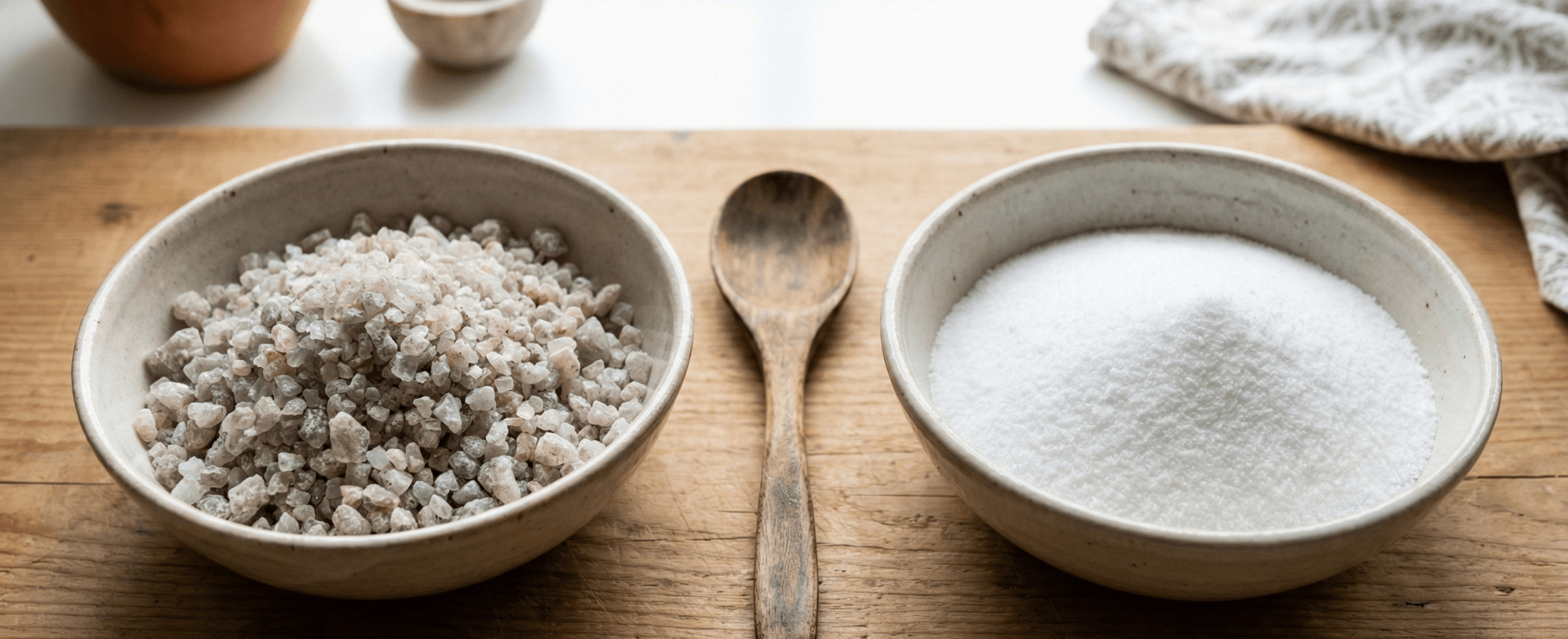
Walk into any traditional South Indian household, and you might see two types of salt in the kitchen: regular iodized table salt for everyday cooking, and rock salt (sendha namak) or sea salt for specific preparations. Ask why, and you’ll get answers ranging from “it tastes better” to “it’s healthier” to “that’s what my mother used.”
The salt debate has become surprisingly complicated. Health-conscious consumers are increasingly choosing non-iodized salts like Himalayan pink salt, sea salt, or rock salt, believing them to be more natural and nutritious. Meanwhile, public health campaigns continue to emphasize the importance of iodized salt for preventing iodine deficiency.
So which is right? The answer, like most things in nutrition, is nuanced.
This isn’t about one salt being universally good and the other bad. It’s about understanding what iodization does, who needs it, who might benefit from non-iodized alternatives, and how to make an informed choice for your family’s specific needs.
Today, let’s cut through the confusion and help you understand the real differences between iodized and non-iodized salt, backed by science and practical wisdom.
Understanding Iodized Salt
Before we compare, let’s understand what iodization actually means.
What is Iodized Salt?
Iodized salt is regular salt (sodium chloride) that has been fortified with small amounts of iodine compounds, usually potassium iodate or potassium iodide.
The amount: Typically 15-40 parts per million (ppm) of iodine, which translates to about 30-50 micrograms per gram of salt.
Why it exists: Iodization was introduced as a public health intervention to prevent iodine deficiency disorders, particularly in regions where soil and water are naturally low in iodine.
When it started: India began mandatory salt iodization in the 1980s, making it one of the most successful public health programs in the country.
The Process of Iodization
Iodization happens at salt production facilities:
- Regular salt is produced (from sea water or rock salt mines)
- Potassium iodate (preferred in India) is added in controlled amounts
- The salt is packaged with anti-caking agents to prevent clumping
- It reaches consumers as iodized table salt
Important: The iodine added is stable and doesn’t change the fundamental nature of salt. You’re still getting sodium chloride, just with added iodine.
Why Iodine Matters
Iodine is an essential trace element that your body cannot produce. You must get it from food or supplements.
Critical functions of iodine:
- Required for thyroid hormone production (T3 and T4)
- Essential for brain development in fetuses and infants
- Regulates metabolism
- Supports cognitive function
- Critical for growth and development in children
Deficiency consequences:
- Goiter (enlarged thyroid)
- Hypothyroidism
- Mental retardation in children (if deficiency during pregnancy)
- Developmental delays
- Reduced cognitive function
- Fatigue and weight gain
The Success Story of Iodization
India’s salt iodization program has been remarkably successful:
- Goiter rates dropped from 30-40% to less than 5% in most regions
- Improved cognitive outcomes in children
- Reduced pregnancy complications
- Near elimination of cretinism (severe iodine deficiency in infants)
This is why health authorities worldwide, including WHO and UNICEF, strongly advocate for iodized salt.
Understanding Non-Iodized Salt
Now let’s look at the other side: natural, non-iodized salts.
Types of Non-Iodized Salt
Sea Salt:
- Produced by evaporating sea water
- Contains trace minerals from the ocean
- Slightly coarser texture than table salt
- Subtle flavor differences
- Our raw natural sea salt (non-iodized) is harvested naturally and retains beneficial minerals
Rock Salt (Sendha Namak):
- Mined from ancient salt deposits
- Used in fasting (vrat) foods
- Considered pure in Ayurveda
- Slightly pink or white color
- Mineral content varies by source
Himalayan Pink Salt:
- Mined from Khewra Salt Mine in Pakistan
- Distinctive pink color from iron oxide and trace minerals
- Contains 84+ trace minerals (in tiny amounts)
- Coarser crystals
- Higher price point
Black Salt (Kala Namak):
- Volcanic rock salt with distinctive sulfur smell
- Used in chaats, raitas, and digestive preparations
- Contains iron sulfide (gives black/purple color)
- Traditional Ayurvedic use
Natural Mineral Content
Non-iodized salts, especially unrefined ones, contain trace amounts of various minerals:
- Magnesium
- Calcium
- Potassium
- Iron
- Zinc
- Manganese
- Other trace elements
Important reality check: While marketing emphasizes these minerals, the amounts are tiny. You’d need to eat massive amounts of salt to get meaningful mineral intake. Don’t choose non-iodized salt primarily for mineral content.
Why People Choose Non-Iodized Salt
Taste preferences: Many chefs and home cooks prefer the subtle flavor differences
Avoiding additives: Non-iodized salts often lack anti-caking agents found in iodized table salt
Traditional/cultural reasons: Certain preparations traditionally use specific salts
Ayurvedic principles: Rock salt is considered sattvic (pure)
Perceived naturalness: Unprocessed salt feels more “natural” to many consumers
Fasting requirements: Rock salt is permitted during religious fasts
The Iodine Deficiency Question
Before choosing non-iodized salt, you need to understand your iodine status.
Who is at Risk of Iodine Deficiency?
High-risk groups:
- Pregnant and breastfeeding women (need 50% more iodine)
- Infants and young children (critical for brain development)
- Vegetarians and vegans (limited iodine sources)
- People living in iodine-deficient regions (mountainous areas, areas far from coast)
- People who consume little dairy or seafood
Medium-risk groups:
- Growing adolescents
- People with existing thyroid conditions
- Women of childbearing age
Lower-risk groups:
- Adults who consume fish, seafood, and dairy regularly
- People supplementing iodine
- People living in coastal areas with iodine-rich soil
Iodine Sources Beyond Salt
If you choose non-iodized salt, you need alternative iodine sources:
Excellent sources:
- Seaweed (kombu, nori) – extremely high
- Fish and seafood – good amounts
- Dairy products – moderate amounts
- Eggs – moderate amounts
Poor sources:
- Vegetables – minimal (depends on soil)
- Fruits – minimal
- Grains – minimal
- Legumes – minimal
Reality check: For vegetarians in India who don’t eat much dairy or seaweed, iodized salt is often the primary iodine source.
Signs of Iodine Deficiency
Pay attention to these symptoms:
- Swelling in the neck (goiter)
- Unexplained weight gain
- Fatigue and weakness
- Thinning hair
- Dry skin
- Feeling colder than usual
- Slowed heart rate
- Memory and learning difficulties
- Heavy or irregular periods
If you experience these: Get your thyroid function tested. Don’t self-diagnose.
The Case for Iodized Salt
Let’s objectively examine when iodized salt is the better choice.
Clear Advantages
- Prevents Iodine Deficiency: This is the primary and undeniable benefit. If you don’t have other reliable iodine sources, iodized salt prevents serious health problems.
- Especially Critical for:
- Pregnant women (developing fetal brain)
- Breastfeeding mothers
- Infants and children
- Adolescents
- Convenience: You don’t need to think about iodine intake. It’s automatically covered through regular cooking.
- Cost-Effective: Iodized salt is inexpensive and widely available. It’s the most economical way to ensure adequate iodine.
- Proven Track Record: Decades of data show iodization has dramatically improved public health outcomes globally.
When Iodized Salt is Essential
You should definitely use iodized salt if:
- You’re pregnant or breastfeeding
- You have children in the household
- You’re vegetarian with limited dairy intake
- You live in mountainous or inland areas (naturally low soil iodine)
- You have no other reliable iodine sources
- You’ve been diagnosed with iodine deficiency in the past
The Case for Non-Iodized Salt
Now let’s look at when non-iodized salt might be appropriate.
Potential Advantages
- No Added Chemicals: Pure sea salt or rock salt contains only naturally occurring minerals, no anti-caking agents or processing chemicals.
- Trace Minerals: While amounts are small, unrefined salts do contain beneficial trace minerals absent in refined table salt.
- Better Taste (Subjective): Many people find natural salts have a cleaner, less “chemical” taste. This is personal preference.
- Ayurvedic Alignment: Rock salt (sendha namak) is considered balancing and pure in Ayurvedic tradition.
- Fasting Appropriate: Rock salt is permitted during religious fasts when regular salt is avoided.
- Less Processing: Natural salts undergo minimal processing compared to industrial table salt.
When Non-Iodized Salt Might Be Appropriate
You might choose non-iodized salt if:
- You regularly consume seafood, fish, and/or dairy (reliable iodine sources)
- You take iodine supplements (consult doctor)
- You have hyperthyroidism or need to limit iodine (medical guidance required)
- You live in coastal areas with iodine-rich soil and diet
- You’ve confirmed adequate iodine levels through testing
- You’re using it for specific traditional preparations while using iodized salt for general cooking
Critical: Don’t choose non-iodized salt just because it seems more “natural” without ensuring you have adequate iodine from other sources.
The Balanced Approach: Using Both
Here’s what many nutritionally-aware households do, and it makes a lot of sense.
The Two-Salt Strategy
Iodized salt for:
- Regular daily cooking (dal, vegetables, rice)
- Children’s meals
- Family meals
- General seasoning
Non-iodized salt for:
- Fasting days (rock salt)
- Finishing salt on salads
- Special preparations where taste matters most
- Traditional recipes requiring specific salts
- Pickles and fermentation (where iodine can interfere)
Ratio: About 80% of your salt intake from iodized, 20% from non-iodized ensures adequate iodine while enjoying variety.
Practical Implementation
Kitchen setup:
- Keep iodized salt in regular salt container for daily use
- Keep rock salt or sea salt in separate container for special uses
- Label clearly to avoid confusion
- Default to iodized unless there’s a specific reason not to
For families with children:
- Always use iodized salt for kids’ meals
- Can use non-iodized for adult-only preparations
- Prioritize iodized for pregnant/nursing mothers
Common Myths About Salt (Debunked)
Let’s clear up some common misconceptions.
Myth 1: “Iodized salt is artificial and unhealthy”
Reality: Iodization adds a natural element (iodine) that your body needs. It’s fortification, not artificial creation. The salt itself is still natural sodium chloride.
Myth 2: “Non-iodized salt is healthier because it’s more natural”
Reality: “Natural” doesn’t automatically mean healthier. If you lack iodine, non-iodized salt contributes to deficiency, which is definitely unhealthy.
Myth 3: “Himalayan pink salt provides enough minerals to replace supplements”
Reality: The trace minerals in pink salt are in such tiny amounts that you’d need to consume dangerous levels of sodium to get meaningful mineral intake. It’s not a significant source.
Myth 4: “Iodine in salt is harmful”
Reality: The amount of iodine in salt is carefully regulated and safe for the vast majority of people. Iodine toxicity from salt alone is extremely rare.
Myth 5: “Sea salt is healthier than table salt”
Reality: Both are sodium chloride. Sea salt may have trace minerals, but sodium content is similar. If sea salt isn’t iodized and you need iodine, regular iodized salt is healthier.
Myth 6: “Salt causes high blood pressure, so avoid it completely”
Reality: Excess sodium contributes to hypertension in salt-sensitive individuals. The solution is moderation (5g/day maximum), not complete elimination. Your body needs some sodium.
Health Considerations Beyond Iodine
Salt choice affects more than just iodine intake.
Sodium Content (The Real Concern)
Whether iodized or not, all salt is primarily sodium chloride. Excess sodium is the real health concern:
Risks of excess sodium:
- High blood pressure (hypertension)
- Increased heart disease risk
- Stroke risk
- Kidney problems
- Calcium loss from bones
Recommended limits:
- WHO recommends less than 5g salt per day (about 1 teaspoon)
- Most Indians consume 9-12g daily (nearly double recommendation)
- Focus on reducing total salt, regardless of type
Processing and Additives
Iodized table salt often contains:
- Anti-caking agents (prevent clumping)
- Iodine (potassium iodate/iodide)
- Sometimes fluoride (in some countries)
Non-iodized natural salts:
- May clump without anti-caking agents
- No fortification
- Sometimes contain natural impurities
The question: Are anti-caking agents harmful? Most are considered safe (magnesium carbonate, calcium silicate), but some people prefer avoiding them.
Special Medical Conditions
Hyperthyroidism:
- Excess iodine can worsen condition
- Doctor may recommend limiting iodized salt
- Medical supervision essential
Hypothyroidism:
- Adequate iodine is crucial
- However, excessive iodine can also be problematic
- Work with your endocrinologist
Kidney disease:
- Sodium restriction is priority
- Type of salt matters less than amount
- Follow medical advice strictly
Pregnancy:
- Iodine needs increase by 50%
- Iodized salt is strongly recommended
- Prenatal vitamins should also contain iodine
How to Choose: A Decision Framework
Use this framework to make the right choice for your situation.
Step 1: Assess Your Iodine Status
High iodine needs? (pregnant, nursing, children, no seafood/dairy) → Choose iodized salt
Adequate alternative sources? (regular fish, seafood, dairy, supplements) → Non-iodized salt is an option
Unsure? → Get thyroid function tested, default to iodized salt meanwhile
Step 2: Consider Your Diet
Vegetarian with limited dairy? → Iodized salt recommended
Regular fish and seafood consumer? → Non-iodized salt is safe
Diverse diet with dairy, eggs, and occasional seafood? → Either works, or use both
Step 3: Factor in Special Needs
Anyone in household pregnant/nursing? → Iodized salt for them essential
Children under 12? → Iodized salt recommended
Medical conditions affecting thyroid? → Follow doctor’s specific guidance
Healthy adults only? → More flexibility in choice
Step 4: Practical Considerations
Budget-conscious? → Iodized salt is more economical
Interested in traditional cooking? → Keep both types for different uses
Fasting regularly? → Need rock salt for fasting, iodized for regular days
Concerned about additives? → Natural non-iodized salt, but ensure iodine from elsewhere
Practical Recommendations by Household Type
For Families with Children
Best approach: Primary use of iodized salt
Why: Children’s developing brains need adequate iodine. Don’t risk deficiency.
Implementation:
- Use iodized salt for all family meals
- Can introduce non-iodized salts to older children (8+) occasionally
- Ensure pregnant/nursing mothers use iodized
- If using non-iodized, supplement diet with dairy and eggs
For Young Adults
Best approach: Iodized salt or mixed approach
Why: Still developing, establishing dietary patterns
Implementation:
- Default to iodized for most cooking
- Can use special salts for specific dishes
- Ensure adequate iodine if choosing primarily non-iodized
- Consider lifestyle and diet diversity
For Older Adults
Best approach: Based on health status and diet
Why: Metabolism slows, but iodine needs continue
Implementation:
- If eating fish/seafood regularly, non-iodized is fine
- If limited diet, stick with iodized
- Priority is reducing total sodium intake
- Monitor thyroid function regularly
For Vegetarians/Vegans
Best approach: Iodized salt unless supplementing
Why: Very limited natural iodine sources in plant-based diet
Implementation:
- Iodized salt is crucial
- Or consume seaweed regularly (nori, kombu)
- Or take iodine supplements (150mcg daily)
- Get thyroid function checked annually
For Health Enthusiasts
Best approach: Balanced use with monitoring
Why: Awareness of nutrition allows informed choices
Implementation:
- Can use non-iodized for taste/preference
- Ensure 150mcg iodine daily from diet or supplements
- Consider occasional thyroid testing
- Track total sodium intake (more important than salt type)
Storing Different Salts
Proper storage maintains quality and prevents issues.
Iodized Salt Storage
Challenge: Iodine can degrade over time, especially with exposure to moisture, heat, and light
Best practices:
- Store in airtight container
- Keep away from stove and direct sunlight
- Cool, dry location
- Use within 1 year for maximum iodine content
- Don’t buy very large quantities
Signs of degradation:
- Clumping (indicates moisture exposure)
- Yellowing (iodine oxidation)
- Off smell
Non-Iodized Salt Storage
Advantage: More stable, less degradation concern
Best practices:
- Airtight containers (prevents moisture)
- Rock salt can be stored long-term
- Sea salt may clump in humid weather (still usable, just break apart)
- Can buy in larger quantities
Different salts:
- Himalayan pink salt: Stores indefinitely
- Sea salt: Best used within 2 years for optimal flavor
- Rock salt: Stores indefinitely
Making the Switch (If You Decide To)
If you’re currently using only iodized salt and want to incorporate non-iodized, or vice versa, do it thoughtfully.
Switching to Non-Iodized
Before switching:
- Assess your diet’s iodine sources
- Consider getting thyroid function tested
- Ensure you’re not in a high-risk category
- Identify alternative iodine sources
Gradual approach:
- Week 1-2: Replace 25% of salt with non-iodized
- Week 3-4: Increase to 50-50 if desired
- Monitor: Note any fatigue, weight changes, or other symptoms
- Retest: Check thyroid function after 3-6 months
Switching to Iodized
If you’ve been using non-iodized and realize you need iodine:
- Switch immediately (no gradual needed)
- Continue using for at least 3 months
- If deficiency was diagnosed, follow doctor’s supplementation advice
- Retest thyroid function after 3 months
The Bottom Line: A Balanced Perspective
Here’s the honest truth: for most Indian households, iodized salt remains the safest, most practical choice. The public health benefits are real and proven. Iodine deficiency has serious consequences, particularly for children and pregnant women.
That said, if you:
- Consume regular seafood, fish, and dairy
- Have confirmed adequate iodine levels
- Want to use traditional salts for specific preparations
- Take iodine supplements under medical supervision
Then incorporating non-iodized salts can be perfectly safe and even enjoyable.
The key is informed choice, not blind following of trends. “Natural” sounds appealing, but deficiency is definitely not natural or healthy.
The smart approach:
- Use iodized salt as your primary cooking salt
- Keep special salts (rock salt, sea salt) for specific uses
- Ensure adequate iodine from diet or salt
- Focus more on reducing total sodium than obsessing about salt type
- Get thyroid function tested if unsure
Your body doesn’t care if the salt is pink, white, or comes from the Himalayas. It cares about getting adequate iodine and not getting excess sodium. Focus on what actually matters.
Choose the salt that makes sense for your health status, dietary pattern, and family needs. Not the one with the prettiest packaging or most exotic origin story.
Looking for quality natural salt? Our raw natural sea salt (non-iodized) is harvested naturally and retains beneficial trace minerals. Perfect for those who already have adequate iodine sources and prefer minimally processed salt.
Remember: If using non-iodized salt, ensure you’re getting iodine from:
- Fish and seafood
- Dairy products
- Eggs
- Iodine supplements (with doctor’s approval)
Pair your healthy salt choice with our nutritious products:
- Organic rice varieties for balanced meals
- Organic millets for complete nutrition
- Organic pulses for protein
- Cold-pressed oils for healthy cooking
Make informed choices for your family’s health!
Health Check Reminder: If you’re switching to non-iodized salt, consider getting your thyroid function (TSH, T3, T4) tested before and 3-6 months after to ensure adequate iodine levels.